Customers overbuy and grocers overstock.
We sit at the counter between them and plan the week for both.
We put a staffed meal-prep counter inside an existing independent grocery store. Shoppers pick recipes in our app, grocery store staff portion the exact quantities out of the store's inventory, and the shopper picks up a labelled box at the counter and pays at the regular till.
The store gets a kind of Instacart-lite (order ahead, buy to demand) without paying for the picking labour, plus a new prep-labour revenue line and less shrink.
The shopper pays the store a 10% service fee and labour at 3× wage. We take $2,000 a month and 5% of spend from the store, and 2.9% from brands. Our wedge is small-town BC independents, starting with a two-store family grocer Ferraro Foods, then rolling out through the independent grocer federation.
14 stores is $9.1M of spend through Motherloaf and $1M a year to us.
A recipe needs half a bunch of celery; the store sells a bunch and bought it before anyone asked.
The family throws out what the recipe did not use. The store throws out what the town did not buy. Of every $100 of food that enters a Canadian grocery store, $29 goes in the bin.
$29
of every $100
What we sell
A counter in the store that sells the right size, so the family stops scraping spinach into the bin and the grocer stops dumping peppers.
A counter in the store. The customer picks the week's meals in the app, we portion each one from the store's own shelves to the recipe, and they pick it up at the counter with the rest of the shop. A $60 dinner costs $54 on average: the same food sold in the right size, and the receipt says so.
$60
As packages
$54
To the recipe
We are not the store and we need one. We chop, so we are in Blue Apron's business, but we do not deliver and the store keeps the sale.
Why it works
Both sides of the checkout waste less, and both keep some of what that saves.
Customer
- Wastes less
- $756 of food no longer thrown out
- Saves money
- $352, after our fees
- Saves time
Grocer
- Wastes less
- $207 of food no longer thrown out
- Sells more
- $92 of sales it did not have
- Buys to the order
- Sells the prep
- $101 a year of labour, at 3× wage
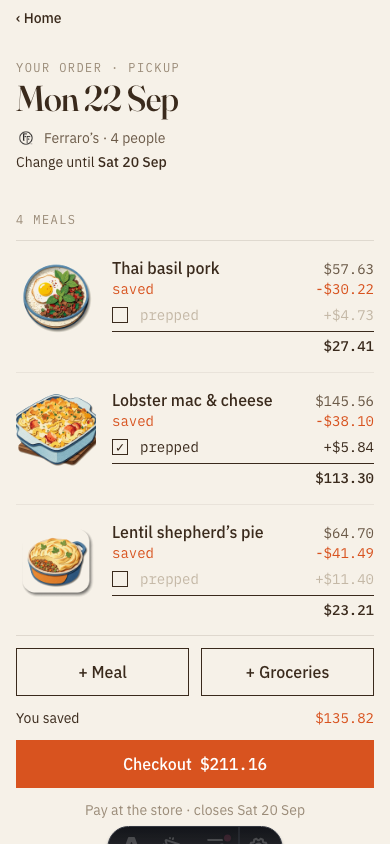
Business model
Of the $166k that is new, we take $56k, and $19k more from brands.
The household pays a 10% service fee and the labour to portion. The store pays a monthly fee and 5% of what goes through the app. Brands pay 2.9% of sales for placement.
- Food not thrown out+$206k
- More sales+$20k
- Labour−$14k
- Margin on food no longer sold−$45k
- Remaining$166k
$75k
Customer ahead
$34k
Store ahead
$75k
Motherloaf, with $19k from brands
Market
Every grocery store in Canada and the US, independents first.
14 stores to $1M a year · 133 stores to $10M
Canada · 15,708 stores
$145B
a year
20% independents
$236M
a year to us, all 3,142 independents signed
United States · 45,575 stores
$1T
a year
38% independents
$3.0B
a year to us, all 17,319 independents signed
Pilot
Three months free at Ferraro's, then we charge.
Ferraro's has two stores, Rossland and Trail, BC, family-owned since 1943. For the pilot we put our own people at the counter and charge nothing for three months.
At three months we report four numbers: store waste before and after, seconds a serving at the counter, households who tried the app, and households still using it. The plan needs 40% tried and 50% still using at month 6.
Then we pitch Castlegar, Nelson, and the independents within an hour of Rossland with the report, and after them the 6,900 members of the Canadian Federation of Independent Grocers.